Submit Inquiry
27 West Beaver Creek Road Unit #2
Richmond Hill, ON, CANADA L4B 1M8

International:

1-905-886-0335

US & Canada:

1-800-265-5696

China Top 10 Sewer Line Pipe Manufacturers for Global Buyers

China’s sewer line pipe industry has become an important sourcing option for municipal contractors, infrastructure developers, and distributors worldwide. The demand is practical and urgent. The WHO and UNICEF Joint Monitoring Programme reported in 2023 that 3.5 billion people lacked safely managed sanitation services in 2022. This gap continues to support investment in wastewater networks, drainage systems, and replacement pipelines.

China offers broad manufacturing capacity, from PVC and HDPE pipes to reinforced concrete and ductile iron systems. However, product quality can differ between factories. It depends on resin grades, wall thickness, joint design, testing equipment, and process control. ISO 4435, EN 1401, ASTM standards, and local project specifications often influence purchasing decisions. These details matter when pipes must withstand soil pressure, chemical exposure, traffic loads, or fluctuating groundwater.

This guide introduces China’s top 10 sewer line pipe manufacturers for global buyers. It considers production experience, export capability, certifications, technical documentation, customization, and after-sales support. Public company information is not always complete. That is a limitation worth acknowledging. A polished website cannot prove long-term field performance. Buyers should request test reports, factory audit records, sample sections, and references from comparable projects. Small details matter, such as a clean socket, readable markings, and consistent pipe ovality. The World Bank and UN-Water have repeatedly linked sanitation investment with public health and urban resilience. Yet price alone remains a tempting shortcut. This list is intended to support careful comparison, not replace independent technical verification.
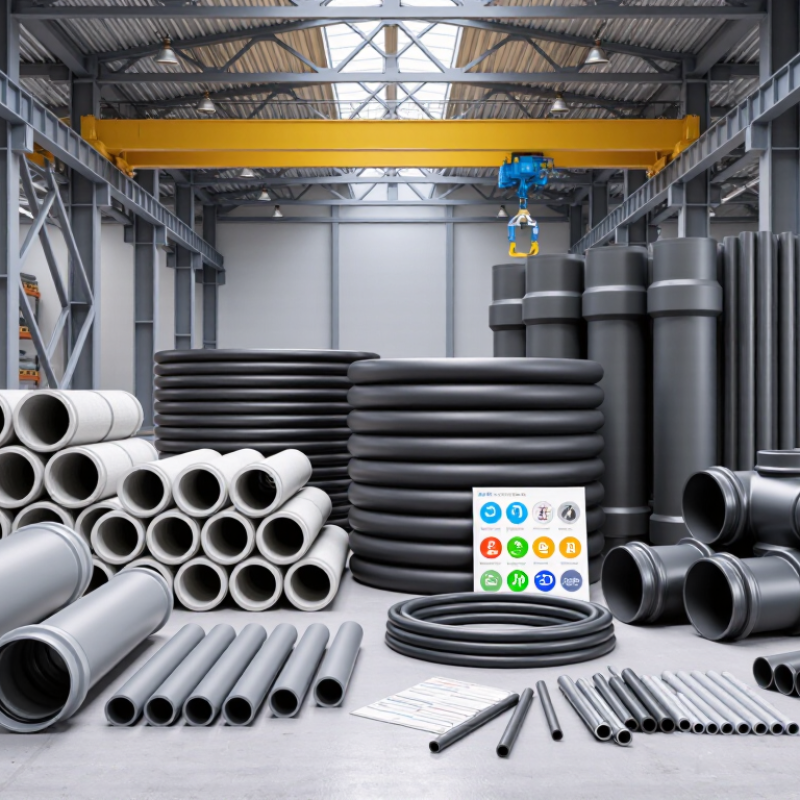
China Top 10 Sewer Line Pipe Manufacturers for Global Buyers

What Sewer Line Pipes Are and Why Manufacturer Selection Matters

Sewer line pipes carry wastewater from buildings, streets, and treatment systems. They work below ground, often unseen for decades. Common options include PVC, HDPE, ductile iron, concrete, and vitrified clay. Each material responds differently to soil pressure, chemicals, temperature, and groundwater.

Manufacturer selection matters because pipe quality begins long before installation. A reliable producer controls resin, steel, cement, or clay inputs carefully. It also checks wall thickness, joint dimensions, stiffness, and pressure resistance during production. Buyers should request test reports, technical drawings, and product traceability records. Clear documentation reduces uncertainty when projects cross borders.

Field experience reveals small details that catalogues may miss. A socket may fit poorly after dust enters the joint. A pipe may crack when bedding is uneven. Good manufacturers provide installation guidance, jointing instructions, and practical responses to site problems. They should understand regional standards and explain differences without hiding behind vague claims. Independent testing adds confidence, especially for large municipal projects.

No selection is perfect. Even experienced engineers can underestimate soil movement or future flow changes. That is why buyers should compare service records, quality systems, inspection procedures, and technical support together. The lowest quotation can become expensive after leaks, excavation, and traffic disruption. A trustworthy manufacturer makes limitations visible, not merely attractive promises.

Materials, Standards, and Production Methods Used in Sewer Line Pipes

China’s sewer line pipe sector serves projects with very different soil, flow, and loading conditions. The US EPA’s 2022 Clean Watersheds Needs Survey estimated 630.1 billion dollars in wastewater infrastructure needs over 20 years. That scale increases demand for durable, traceable pipe systems.

PVC-U and HDPE are common for light, corrosion-resistant gravity sewers. HDPE is usually extruded or spiral-wound, while PVC-U is produced through controlled extrusion and socket forming. Reinforced concrete remains practical for large diameters and heavy traffic loads. Ductile iron offers high strength, but protective linings are essential in aggressive wastewater. Glass-reinforced plastic uses resin and glass fibers, often formed by centrifugal casting. Each material has weaknesses. Plastic can deform under poor backfill.

Buyers should compare compliance with GB/T 19472.1, EN 1401, ISO 21138, or ASTM D3034, depending on the project location. These standards address dimensions, stiffness, joint performance, and testing requirements. The Water Environment Federation notes that infiltration and inflow can significantly increase collection-system loads, making joint quality especially important. Factory checks should include ring stiffness, hydrostatic leakage, impact resistance, and batch traceability. Production speed is not enough. A beautifully smooth pipe may still fail after uneven bedding. Inspection records sometimes look stronger than field practice, so independent testing deserves serious attention.

How to Evaluate Chinese Sewer Line Pipe Manufacturers

How to Evaluate Chinese Sewer Line Pipe Manufacturers

Choosing among China’s top sewer line pipe manufacturers requires more than comparing export prices. The WHO/UNICEF Joint Monitoring Programme reported that 3.5 billion people lacked safely managed sanitation in 2022. Demand is growing, but quality failures can damage roads, contaminate soil, and create expensive repairs. Buyers should match pipe material, diameter, stiffness class, joint design, and chemical resistance with project conditions.

Request recent test reports for ring stiffness, impact strength, dimensional tolerance, leakage, and joint performance. Confirm that testing follows applicable standards, such as GB/T, ISO, ASTM, or EN requirements. A factory should provide batch numbers, resin or compound records, production dates, and calibration certificates. Traceability matters. One missing document may indicate a weak control process.

Visit the production site, but do not trust appearances alone. Ask to inspect extrusion lines, moulds, storage areas, and rejected products. Independent pre-shipment inspection can verify wall thickness and packing accuracy. Review five years of export experience, installed-project references, complaint records, and response times. A low quotation may exclude testing, tooling, or replacement costs. My own evaluation could still miss a hidden defect, especially when samples are unusually well prepared. Buyers should therefore test random production pieces, not only approved samples.

China’s Top 10 Sewer Line Pipe Manufacturers for Global Buyers

China’s Top 10 Sewer Line Pipe Manufacturers for Global Buyers should be assessed beyond production volume. The global need is substantial. The WHO and UNICEF Joint Monitoring Programme reported that 3.5 billion people lacked safely managed sanitation in 2022. This pressure supports demand for durable sewer networks, especially in rapidly urbanizing regions.

China’s National Bureau of Statistics reported an urbanization rate above 66% in 2023. That growth requires pipes for residential districts, industrial parks, and stormwater systems. The top ten manufacturers should therefore demonstrate tested ring stiffness, hydraulic performance, and joint reliability. Their product ranges may include PVCHDPEreinforced concrete, and structured-wall systems. Material choice must match soil movement, groundwater, load conditions, and installation depth.

Fortune Business Insights valued the global plastic pipes market at about 48.85 billion dollars in 2023. It also projected continued growth through 2030. However, a factory’s export history does not prove long-term field performance. Buyers should review ISO 9001 records, third-party test reports, dimensional tolerances, and batch traceability. Site audits are useful. So are sample inspections.

Some manufacturers present impressive laboratory results but provide limited installation guidance. That gap deserves attention. Global buyers should compare warranty terms, technical drawings, lead times, and replacement support before ranking suppliers. A lower quotation may hide thicker packaging needs, inconsistent socket dimensions, or higher freight losses. The strongest candidates combine verified manufacturing controls with practical experience on international sewer projects.

Quality Checks, Export Services, and Purchasing Considerations

Global buyers comparing the top ten sewer line pipe manufacturers should look beyond catalog photos. In field procurement, wall thickness, joint accuracy, and internal lining often decide project reliability. Request mill certificates, dimensional reports, and test results for each production batch. Check pressure, ring stiffness, impact, and watertightness performance against the project specification. A polished sample proves little. Ask for traceable records. Confirm whether testing is performed in-house or by an independent laboratory. Small gaps matter. I once saw a shipment delayed because markings differed from approved drawings. That mistake was avoidable, but not unusual.

Export capability deserves equal attention. Suppliers should provide secure packaging, moisture protection, loading photos, and clear container plans. Long pipes can arrive damaged when supports are poorly spaced. Request a realistic lead time, not an optimistic promise. Confirm Incoterms, customs documents, insurance responsibilities, and replacement procedures before payment. Experienced teams can explain port handling and installation constraints in plain language. Communication speed helps, but accurate answers matter more. A supplier that admits a limitation may be safer than one that guarantees everything.

Tips: Compare at least three quotations using the same technical schedule. Inspect one finished batch before mass production. Verify pipe diameter, length, coating, socket dimensions, and marking consistency. Keep approved drawings attached to the purchase order. Ask for spare joints and repair materials when practical. Do not judge only by the lowest price. Freight, rejected pieces, and site delays can erase early savings. My own checklist still misses details sometimes, so an independent pre-shipment inspection is worth considering for large orders.

China Top 10 Sewer Line Pipe Manufacturers for Global Buyers - Quality Checks, Export Services, and Purchasing Considerations
Rank Manufacturer Profile Main Product Focus Typical Materials Typical Size Range Relevant Standards Recommended Quality Checks Export Services Purchasing Considerations
01 Large-Diameter PVC Sewer Specialist Gravity sewer and drainage pipes for municipal infrastructure PVC-U DN200–DN1200 ASTM D3034, ASTM F679, ISO 4435, EN 1401 Dimensional inspection, ring stiffness, impact resistance, hydrostatic pressure testing, socket and spigot verification Container loading plans, export packing, inspection coordination, commercial invoices, packing lists, certificates of origin Confirm burial depth, soil conditions, SN rating, joint design, and local approval requirements
02 Structured-Wall Pipe Producer Lightweight gravity sewer, stormwater and drainage systems HDPE, PP, PVC-U DN300–DN3000 EN 13476, ISO 21138, relevant project specifications Ring stiffness, profile geometry, weld or socket integrity, leakage testing, dimensional stability, raw-material traceability Custom lengths, lifting and stacking guidance, technical drawings, third-party factory inspection support Compare stiffness classes rather than wall thickness alone; review installation bedding and backfill requirements
03 High-Density PE Sewer Pipe Producer Flexible sewer mains, outfalls and trenchless rehabilitation PE80, PE100, PE100-RC OD110–OD1600 EN 12666, ISO 4427 where applicable to pressure systems, ASTM F714 for pressure applications Melt-flow rate, carbon-black dispersion, oxidation induction time, ovality, wall thickness, butt-fusion coupon testing Fusion procedure documentation, coil or straight-length supply, heat-number records, export seaworthy packaging Define pressure or non-pressure duty, SDR, temperature, fusion method, and minimum bending radius
04 Municipal Sewer Project Manufacturer Complete pipe, fitting and manhole connection packages PVC-U, HDPE, PP DN160–DN1200 ISO 4435, EN 1401, EN 1852, project-specific municipal standards Batch sampling, dimensional tolerances, gasket compatibility, joint watertightness, visual inspection and lot traceability Bill-of-quantities review, shop drawings, installation manuals, consolidated shipment planning Request a complete bill of materials and verify compatibility among pipes, fittings, seals and chambers
05 Corrugated PE/PP Pipe Manufacturer Stormwater drainage, culverts and non-pressure sewer networks HDPE, PP DN200–DN2000 EN 13476, ISO 21138, ASTM F405 or F667 for applicable corrugated products Ring stiffness, buckling resistance, profile dimensions, low-temperature impact, joint sealing and deflection checks Length optimization, palletization, container utilization calculations, unloading recommendations Assess stiffness class, traffic load, groundwater level, trench width and installation quality controls
06 PVC-U Drainage Pipe Manufacturer Residential, commercial and utility drainage systems PVC-U DN110–DN630 EN 1401, ISO 4435, ASTM D3034 Wall thickness, socket depth, gasket seating, Vicat softening temperature, impact resistance and leakage testing Color and marking customization, mixed-size container loading, product certificates and installation instructions Check whether metric or inch dimensions are required and match rubber-ring profiles with local fittings
07 Trenchless Rehabilitation Pipe Supplier Sliplining, pipe bursting and close-fit replacement projects HDPE, PE100-RC OD160–OD1200 ISO 4427 or EN 12201 for applicable pressure products; project trenchless specifications Slow-crack-growth resistance, tensile properties, fusion quality, ovality, surface damage limits and re-rounding performance Welding parameter sheets, pull-in calculations, coil management and site technical support Confirm host-pipe geometry, pull-in force, allowable tensile load, access-pit dimensions and installation method
08 Industrial Wastewater Pipe Manufacturer Corrosion-resistant industrial effluent and process drainage HDPE, PP, PVC-U DN50–DN1000 Applicable ISO, EN or ASTM product standard plus chemical-resistance requirements Chemical compatibility review, temperature resistance, dimensional checks, joint testing and material identification Technical data sheets, chemical-resistance charts, sample approval and project-based packaging Provide chemical concentration, operating temperature, flow conditions and cleaning procedures before selection
09 Custom Fittings and Sewer Accessories Producer Bends, tees, reducers, repair couplings and transition fittings PVC-U, HDPE, PP, elastomeric seals DN50–DN1600 EN 476, EN 1401, ISO 4435, ISO 21138 and applicable fitting standards Angle and dimension verification, pressure or leakage tests, weld inspection, gasket compatibility and visual checks CAD drawing review, custom tooling, sample approval, spare-parts packaging and consolidated export shipment Confirm outside diameter series, connection method, bend radius, joint type and required tolerances
10 Export-Oriented Sewer Pipe Factory Mixed project orders for distributors, contractors and infrastructure buyers PVC-U, HDPE, PP DN110–DN3000 ISO, EN, ASTM or national standards specified in the purchase contract Pre-shipment inspection, batch traceability, third-party laboratory testing, marking verification and loading supervision FOB, CFR and CIF quotations, container optimization, export documentation, translation support and after-sales coordination Compare total landed cost, minimum order quantity, lead time, payment terms, warranty scope and claims procedure
Buyer Note: The profiles above are anonymous manufacturer categories rather than named companies or brands. Product ranges and standards should be verified against the supplier’s current technical datasheets, test reports, applicable local regulations and project specifications before purchase.
123