
Submit Inquiry
27 West Beaver Creek Road Unit #2
Richmond Hill, ON, CANADA L4B 1M8

International:

1-905-886-0335

US & Canada:

1-800-265-5696

10 Best Machine Safety Fence Manufacturers Worldwide?

Industrial machinery can look controlled from a distance. Up close, exposed robot arms, conveyors, and sharp tooling create very different risks. A correctly designed Machine Safety Fence helps separate people from hazardous movement while preserving visibility, access, and production flow.

The International Labour Organization estimated nearly three million work-related deaths annually in its 2023 global report. It also recorded about 395 million non-fatal occupational injuries. These figures explain why physical guarding remains important, even as factories adopt sensors and connected safety systems. MarketsandMarkets valued the global machine safety market at approximately USD 5.4 billion in 2023. Its report projects the market to reach about USD 8.3 billion by 2028. Demand is supported by industrial automation, stricter risk controls, and growing investment in safer production lines.

This article evaluates ten leading Machine Safety Fence manufacturers worldwide. The comparison considers panel strength, mesh visibility, modular design, door integration, installation support, and compatibility with safety switches. It also examines practical details, such as whether one technician can replace a damaged panel or whether a gate aligns after repeated use. ISO 14120 remains a useful reference for fixed and movable guards, but compliance depends on the complete machine system, not the fence alone. No ranking is perfect. Local standards, guarding distances, robot reach, and maintenance habits can change the best choice. Buyers should verify technical drawings, test certificates, and supplier experience before ordering. A low initial price may become expensive when custom brackets, delayed parts, or difficult maintenance appear later.
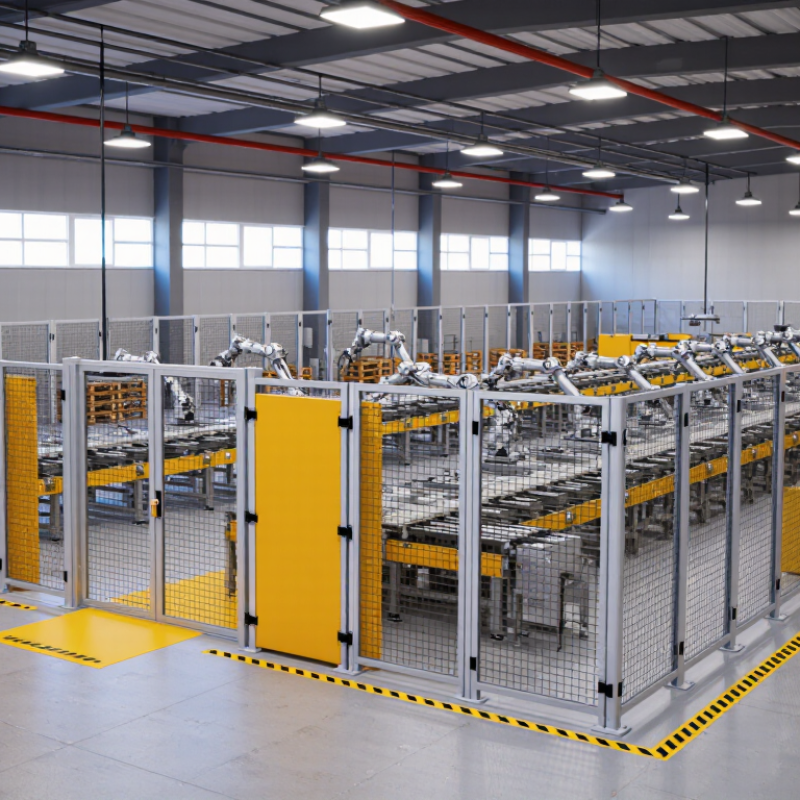
10 Best Machine Safety Fence Manufacturers Worldwide?

Machine Safety Fence Basics: ISO 14120, ISO 12100, and OSHA 1910.212

Machine safety fences begin with risk assessment, not steel mesh. ISO 12100 requires hazards to be identified, risks estimated, and protective measures selected systematically. A practical review examines crushing points, stored energy, moving tools, access frequency, and maintenance tasks. A fence that blocks normal operation may still fail during cleaning.

ISO 14120 defines core requirements for fixed and movable guards. It addresses strength, visibility, secure fixing, tamper resistance, and safe access. In real inspections, small gaps around posts often deserve more attention than the main panels. OSHA 1910.212 also requires machine guarding against hazards such as point-of-operation injuries, flying chips, and rotating parts. The OSHA standard does not replace a detailed risk assessment.

The U.S. Bureau of Labor Statistics recorded 885 fatal work injuries involving contact with objects and equipment in 2023. That category includes machinery-related events, but it does not prove that fencing alone prevents them. Guard selection still needs evidence.

Check the manufacturer’s drawings, load data, installation instructions, and inspection records. Ask whether panels remain secure after impact or repeated door use. My own design reviews have exposed weak assumptions about maintenance access. The safest barrier is sometimes the one workers can use correctly, not the one that looks strongest. Even experienced teams miss this.

Ranking Criteria: Safety Ratings, ISO 13857 Clearances, and Total Cost

10 Best Machine Safety Fence Manufacturers Worldwide

Choosing the 10 best machine safety fence manufacturers requires more than comparing catalogs. The ranking centers on safety ratings, ISO 13857 clearances, and total cost. Practical evaluation begins with documented test evidence, guard strength, gate performance, and resistance to tampering. A credible manufacturer should explain how its panels, posts, doors, and fixing systems perform around real machinery.

ISO 13857 clearance data deserves close inspection. Openings must prevent a hand, arm, or body from reaching hazardous moving parts. Measurements can change with the hazard position, access direction, and fence height. I would compare technical drawings against the actual production layout, not rely on attractive product images. Small gaps near conveyors often create expensive redesigns. Details matter.

Total cost includes more than the purchase price. Freight, installation time, floor anchors, replacement panels, access gates, and future modifications can quickly change the ranking. A lower-priced system may require extra engineering or frequent adjustments. A higher-priced option may reduce downtime, but only when its documentation and support are dependable. No ranking is perfectly objective. A spreadsheet can miss poor site access or difficult cleaning routines. Therefore, the strongest candidates combine verified safety performance, precise clearance control, practical installation experience, and transparent lifecycle pricing.

10 Best Machine Safety Fence Manufacturers Worldwide: A Data-Based Review

This data-based review compares ten machine safety fence manufacturers using measurable criteria: guarding coverage, mesh visibility, access control, modularity, documentation, and installation support. The benchmark follows ISO 14120 for guards and ISO 13857 for safety distances. It also considers evidence from factory projects, not only catalogue claims. Small details matter, including rigid posts, tamper-resistant fixings, clear access doors, and stable floor anchoring.

The wider safety context is serious. The International Labour Organization reported approximately 2.93 million work-related deaths and 395 million non-fatal injuries globally in 2023. These figures do not measure fence performance directly, but they show why physical guarding deserves careful evaluation. Grand View Research also identifies industrial safety as a growing global market, driven by automation, machinery investment, and stricter risk controls. In practice, the strongest manufacturers provide drawings, load information, replacement-part data, and documented testing. Some suppliers offer impressive modular systems, yet their installation guidance can be vague.

Our comparison gives greater weight to verified technical evidence than marketing language. A practical scoring model assesses safety design at 30%, engineering documentation at 25%, installation flexibility at 20%, durability at 15%, and service support at 10%. The weighting is not perfect. It may undervalue local engineering response or real maintenance experience. That weakness should remain visible. A fence can meet a standard and still fail when a gate is poorly aligned, a panel is damaged, or operators bypass access controls. Buyers should inspect completed installations and request risk-assessment records before choosing among the ten manufacturers.

Manufacturer Comparison: Certifications, Mesh Systems, Customization, and Lead Times

Choosing among the 10 best machine safety fence manufacturers requires more than comparing steel prices.

The right supplier provides evidence against ISO 14120 for guards and ISO 13857 for safety distances. ISO 12100 should guide risk assessment, not replace it.

The International Federation of Robotics reported 541,302 industrial robots were installed worldwide in 2023. That volume increases demand for consistent guarding around cells, conveyors, and palletizing zones.

Ask for current certificates, scope statements, and test records. A logo alone proves little.

Mesh systems differ in panel pitch, wire diameter, frame strength, coating, and access-door design. Fine mesh can reduce reach-through risk, while larger openings may improve visibility and airflow.

Confirm the measured opening, not the marketing label. Check posts, clamps, interlocks, hinges, and floor anchors as one system.

Occupational safety guidance treats safety distance as a calculation linked to reach and hazard movement. A fence may look solid but fail at a poorly placed gate.

This detail is often underestimated.

Customization should cover robot clearance, uneven floors, transfer points, removable panels, and future line changes.

Request a 2D layout, load assumptions, finish specification, and maintenance access before approval.

Lead times should separate engineering, fabrication, coating, inspection, and delivery. Some quotes hide the first four.

Ask for milestone dates and spare-panel availability. Be cautious with promises below four weeks; approvals or imported components may be excluded.

Fast delivery can create slow installation when drawings remain incomplete.

Choosing the Right Supplier: Risk Level, Performance Level, and Global Support

10 Best Machine Safety Fence Manufacturers Worldwide?

Choosing the Right Supplier: Risk Level, Performance Level, and Global Support

A machine safety fence is not merely a steel boundary. It must match the hazard, access frequency, stopping time, and maintenance workflow. The International Labour Organization’s 2023 report estimates 2.93 million work-related deaths annually, with about 395 million non-fatal occupational injuries. These figures make risk-based guarding a practical responsibility, not a purchasing detail.

Begin with the required risk level. A supplier should support documented assessments using ISO 12100, then help engineers define the required Performance Level under ISO 13849-1 or the appropriate safety integrity level under IEC 62061. The fence alone does not achieve PLr. Interlocks, emergency stops, control logic, and validated stopping distances matter too. Ask for test evidence, drawings, material specifications, and clear separation-distance calculations. Small gaps can create serious exposure.

Global support is equally important. Reliable suppliers provide local installation guidance, multilingual manuals, replacement panels, and responsive technical assistance. They should understand regional machine standards without treating compliance as a checkbox. In real factories, damaged mesh and missing fasteners often appear after routine changes. A weak after-sales process can undermine a well-designed system. This is an uncomfortable point: the cheapest quotation may become the most expensive option after one production interruption. Verify lead times, modification capability, training, and validation support before comparing prices. Reference: International Labour Organization, A Call for Safer and Healthier Working Environments, 2023.

10 Best Machine Safety Fence Manufacturers Worldwide? - Choosing the Right Supplier: Risk Level, Performance Level, and Global Support

Standards-based supplier comparison framework. Company names and brand-specific claims are intentionally excluded; all technical requirements should be verified with the selected supplier.

Rank Anonymous Manufacturer Profile Typical Safety-Fence Offering Typical Panel Height Common Mesh / Opening Range Suitable Risk Level Indicative PLr Target Required Compliance Evidence Global Support Evidence to Request Best-Fit Application
1 Integrated Global Guarding Specialist Modular wire-mesh panels, swing doors, sliding doors, roof sections, and configurable access control. 1,400–2,500 mm 20–50 mm typical Medium to high, following a documented ISO 12100 risk assessment. c–e ISO 14120 guard design; ISO 14119 interlocking; ISO 13849-1 safety-related control documentation. Local installation partners, multilingual manuals, spare-parts process, and response-time commitments. Automated production lines, robotic cells, and high-throughput manufacturing plants.
2 Heavy-Duty Industrial Barrier Manufacturer Reinforced steel fencing, impact-resistant posts, protected gates, and floor-anchored systems. 1,800–3,000 mm 30–60 mm typical High, where mechanical impact and access prevention are significant hazards. d–e Mechanical strength and containment test data; ISO 14120 design documentation; anchoring specifications. On-site surveys, structural calculations, regional fabrication capacity, and replacement-panel availability. Press lines, material-handling systems, foundries, and areas exposed to forklift traffic.
3 Robotic Cell Safety Specialist Close-mesh fencing, robot-cell doors, coded interlocks, access monitoring, and perimeter integration. 1,600–2,500 mm 20–40 mm typical High, especially for unexpected robot movement and restricted access zones. d–e ISO 10218-2 integration evidence where applicable; ISO 14119 interlock selection; ISO 13849-1 validation. Robot-integration engineering, safety validation support, remote diagnostics, and local commissioning. Robotic welding, palletizing, assembly, machine tending, and automated inspection cells.
4 Flexible Modular Fencing Manufacturer Tool-free or rapid-assembly panels, adjustable posts, removable sections, and expansion-ready layouts. 1,000–2,200 mm 20–50 mm typical Low to medium, provided minimum separation distances are maintained. b–d ISO 14120; ISO 13855 separation-distance calculations; layout drawings showing reach-through prevention. Short lead times, modular spare components, CAD libraries, and change-order support. Packaging lines, pilot plants, temporary production layouts, and frequently modified cells.
5 Cleanable and Hygienic Guarding Manufacturer Corrosion-resistant panels, smooth surfaces, hygienic supports, washdown-compatible doors, and sealed fittings. 1,200–2,400 mm 20–50 mm typical Medium to high, with additional sanitation and contamination-control requirements. c–d Material certificates, corrosion-resistance data, cleanability information, ISO 14120, and interlock documentation. Washdown installation guidance, hygienic design review, material traceability, and regional service support. Food processing, beverage production, pharmaceutical, and medical-device manufacturing.
6 Machine-Tool Enclosure Specialist Sheet-metal or polycarbonate enclosures, sliding doors, viewing windows, and chip or coolant containment. 900–2,200 mm Solid panels or 20–40 mm mesh Medium to high, depending on rotating tools, ejected parts, and stored energy. c–d ISO 14120; material and impact data; ISO 14119 interlocking; visibility and access-maintenance assessment. Machine-specific engineering, retrofit capability, replacement-window supply, and field-service coverage. CNC machining centers, turning centers, grinding equipment, and standalone machine tools.
7 High-Visibility Safety Fence Manufacturer Open-mesh panels, high-contrast finishes, visibility-focused doors, and clear line-of-sight layouts. 1,400–2,500 mm 20–40 mm typical Medium, where operator visibility and routine access are important. c–d ISO 14120; ISO 13855 separation distances; visibility, reach-through, and gate-access assessment. Layout engineering, color and finish options, documented installation instructions, and regional distributors. Assembly lines, conveyor systems, inspection areas, and facilities requiring visual supervision.
8 Custom Engineered Safety-System Provider Application-specific guarding, custom doors, transfer openings, safety PLC integration, and validation services. Project-specific Project-specific Medium to high, particularly for complex or non-standard machinery. c–e ISO 12100 risk assessment, ISO 13849-1 validation, ISO 14120 guarding design, and electrical schematics. Single-point project management, FAT/SAT support, documented validation, and multi-country commissioning. Large turnkey lines, brownfield upgrades, and machinery with unusual access or process constraints.
9 Fast-Delivery Standard-System Manufacturer Standard panels, posts, gates, brackets, and stocked accessories for rapid installation. 1,000–2,000 mm 20–50 mm typical Low to medium, subject to machine-specific risk assessment and separation distances. b–c ISO 14120 product documentation, installation drawings, anchoring details, and gate hardware specifications. Published stock levels, delivery-time commitments, online technical documents, and regional warehouses. Small machine cells, conveyor guarding, maintenance-area separation, and urgent retrofit work.
10 Regional-Partnered Global Supplier Standard and customized fence systems delivered through local engineering, distribution, and installation partners. 1,200–2,500 mm 20–60 mm typical Medium to high, depending on local engineering competence and validation quality. c–d Declaration and technical file support, ISO 14120, ISO 14119, ISO 13849-1, and country-specific machinery requirements. Named local partner, service territory, training records, escalation route, and spare-parts continuity plan. Multisite manufacturers requiring consistent guarding specifications across different countries.
Selection note: Risk level and the required Performance Level (PLr) must be determined for the complete machine safety function, not selected from the fence alone. Confirm the final design against ISO 12100, ISO 13849-1, ISO 14120, ISO 14119, ISO 13855, and applicable local machinery regulations.
123