How to Choose a Non-Aging Foam Sandwich Panel in 2026?
Choosing a Non-Aging Foam Sandwich Panel in 2026 requires more than comparing prices or glossy product photos. A reliable panel should resist thermal drift, moisture absorption, dimensional change, and facing corrosion throughout its service life. In practice, performance begins with the core. Closed-cell foam, stable bonding, and carefully selected facings can protect insulation from daily temperature swings. Yet “non-aging” is not magic. No panel remains perfect without suitable design, installation, and maintenance. That limitation deserves honest attention.
This guide frames selection around evidence that engineers can verify. Review declared thermal conductivity, density, water absorption, compressive strength, fire behavior, and adhesion data. Ask whether testing reflects the intended climate, load, and exposure. A cold-storage wall may face condensation at 2°C, while a warehouse roof may endure intense sunlight and repeated expansion. Small details matter. Check joint geometry, protective films, fasteners, edge sealing, and replacement access. Request current technical datasheets, independent test reports, batch traceability, and a warranty with clear exclusions. Supplier confidence should be measurable, not merely persuasive.
Field experience also changes the decision. A panel that performs well in a laboratory may fail when cut carelessly or stored on wet ground. Inspect samples for flatness, bond consistency, damaged corners, and surface defects. Speak with installers who have handled similar buildings. Their mistakes can reveal hidden costs. Compare lifecycle value, not only purchase price. Energy savings and fewer repairs may justify a higher initial cost, but assumptions need checking. This 2026 selection approach helps buyers balance verified performance, local conditions, and practical accountability. It may not remove uncertainty. It can make uncertainty visible before the panels reach the site.
What Is a Non-Aging Foam Sandwich Panel?
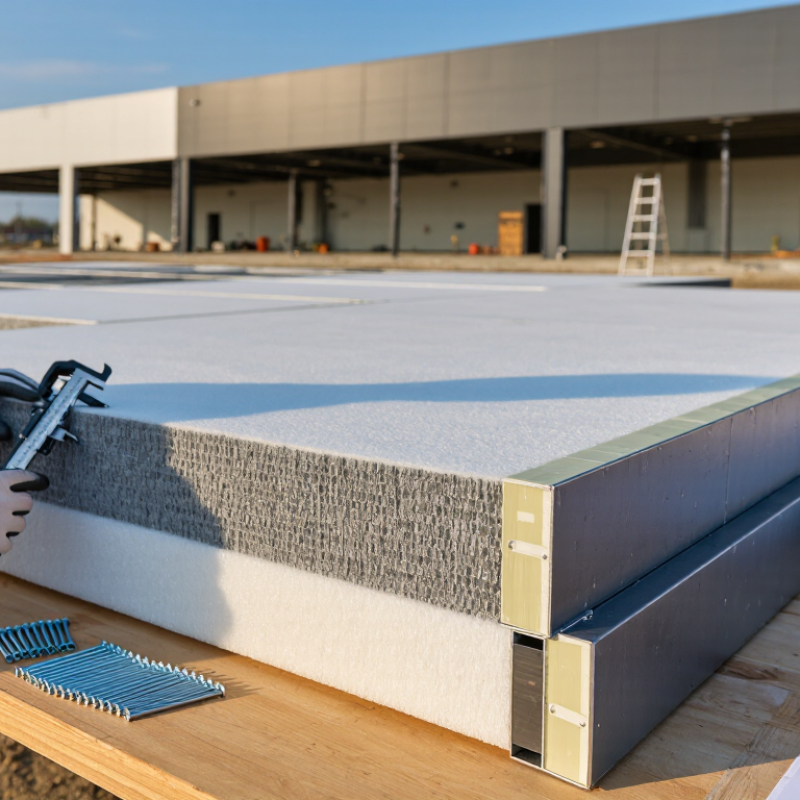
A non-aging foam sandwich panel is an insulated building component designed to retain its thermal and structural performance over time. It usually has a rigid foam core between two protective metal or composite skins. The core may use PIR, PUR, EPS, or XPS foam. “Non-aging” does not mean permanent or completely unchanged. It generally describes limited thermal drift, moisture absorption, dimensional movement, and chemical degradation under stated conditions.
The concept matters because buildings and construction consumed 32% of global energy in 2022, according to the 2024 Global Status Report for Buildings and Construction from UNEP and GlobalABC. A stable insulation core can help maintain heating and cooling efficiency during long service periods. However, foam density alone proves little. Engineers should examine declared thermal conductivity, water absorption, compressive strength, dimensional stability, and tested aging performance. EN 14509 provides a recognized framework for assessing factory-made insulated panels.
In practical inspections, check whether the panel edges remain dry and straight after storage. Look for crushed corners, loose skins, and uneven joints. Small defects can create thermal bridges. A little caution matters. I would also question any absolute “zero-aging” claim, because temperature cycles, sunlight, moisture, and installation quality affect real performance. Test reports should identify the method, exposure period, temperature range, and post-aging results. Without those details, “non-aging” is only a marketing phrase, not a dependable technical description.
Which Core Materials Resist Aging Best in 2026?
How to Choose a Non-Aging Foam Sandwich Panel in 2026?
Core material determines how well a foam sandwich panel survives heat, moisture, and repeated temperature changes. In 2026, PIR foam remains a strong choice for long-term thermal stability. Its closed-cell structure limits water absorption, while its dimensional stability reduces joint movement. PUR foam can also perform well, but its durability depends heavily on density, facing quality, and production control.
PET foam deserves closer attention. It offers good resistance to moisture, chemicals, and repeated loading, making it useful in transport and industrial enclosures. XPS resists water effectively and keeps its shape under many conditions, yet prolonged heat exposure can reduce performance. Phenolic foam has excellent fire and insulation properties, but it may become brittle. That weakness is easy to overlook.
I have seen panels age early because installers focused only on the advertised insulation value. Small gaps around fasteners later became dark, damp lines. Core choice matters, but so do sealed edges, compatible adhesives, and protected facings. Request tested thermal conductivity, water absorption, dimensional change, and aging data under heat and humidity. Standards such as EN 14509 and ASTM C518 can support comparison, but laboratory results do not perfectly predict every building.
No core is truly non-aging. That phrase is too absolute. A better decision considers climate, load, fire requirements, and maintenance access. My own preference can change after reviewing the exposure conditions. That is the point.
What Standards Confirm Long-Term Panel Performance?
How to Choose a Non-Aging Foam Sandwich Panel in 2026?
What Standards Confirm Long-Term Panel Performance?
A “non-aging” foam sandwich panel should be treated carefully. No insulation stays unchanged forever. Heat, moisture, sunlight, joints, and installation quality all influence service life. In field inspections, I have seen panels with excellent cores fail because water entered through poorly sealed edges. The label alone is not proof.
Start with EN 14509 for self-supporting insulated metal panels. It evaluates thermal performance, mechanical resistance, dimensional stability, and durability-related properties. For polyurethane or polyisocyanurate foam, EN 13165 helps verify insulation requirements. ASTM C518 can confirm thermal conductivity, while ASTM C1029 may apply to spray-applied foam materials. Check the exact product scope before accepting any test report.
Fire performance also needs independent evidence. EN 13501-1 classifies reaction to fire in European projects. ASTM E84 measures flame spread and smoke development in North American applications. These tests do not prove unlimited durability. They only describe tested behavior under defined conditions.
Ask for laboratory reports, production-batch traceability, density results, water absorption data, and accelerated aging tests. ASTM C272 can support water absorption evaluation. Compression and adhesion testing also matter around fasteners and panel joints. I once focused too heavily on thermal conductivity and overlooked joint movement. That mistake was expensive. Review the standard, the test date, and the installation environment together.
How to Choose a Non-Aging Foam Sandwich Panel in 2026?
Standards do not define a universal “non-aging” panel. Long-term performance should be verified through aged thermal-conductivity data, declared U-value calculations, moisture resistance, dimensional stability, mechanical performance, and durability testing.
EN 14509 Use for factory-made insulated sandwich panels, including thermal, mechanical, fire, and durability performance assessment.
EN 13165 Use for factory-made rigid polyurethane and polyisocyanurate insulation products, including declared thermal conductivity and ageing procedures.
ISO 6946 Use to calculate thermal resistance and thermal transmittance of building components from material and surface-layer values.
ASTM C518 Use as a heat-flow-meter method for measuring the steady-state thermal transmission properties of insulation materials.
Chart basis: calculated thermal resistance R = thickness ÷ thermal conductivity, using an illustrative aged-design conductivity of 0.022 W/(m·K). Actual panel values must be confirmed from the product declaration and the applicable test standard.