
Submit Inquiry
27 West Beaver Creek Road Unit #2
Richmond Hill, ON, CANADA L4B 1M8

International:

1-905-886-0335

US & Canada:

1-800-265-5696

What Is a Sock Making Machine and How Does It Work?

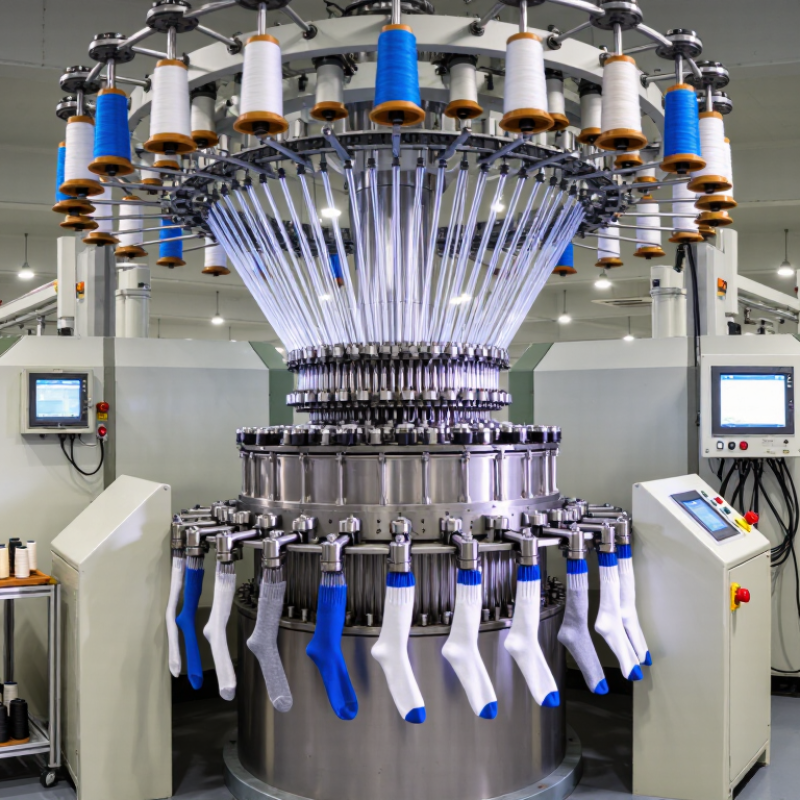
A Sock Making Machine is a computerized knitting system that forms yarn into a complete sock, often with minimal manual sewing. Its work begins with yarn feeding. Needles then create thousands of connected loops around a small cylinder. Heel shaping, toe closure, ribbing, and pattern changes follow programmed instructions. The result can emerge almost finished.

David J. Spencer, a respected knitting-technology researcher, describes the core principle clearly: “Knitting is the process of forming a fabric by the intermeshing of loops.” This simple sentence explains the machine’s foundation. However, modern sock production is far more precise than the definition suggests. A machine must control needle timing, yarn tension, cylinder speed, and electronic patterning at the same time. One small setting can create a visible flaw.

Industry data shows why this technology matters. Textile Exchange’s Materials Market Report 2024 reported that global fiber production reached about 124 million tonnes in 2023. It also projected growth toward 160 million tonnes by 2030. These figures increase pressure to reduce waste, improve durability, and monitor material use. A high-quality Sock Making Machine can support these goals through accurate yarn placement and repeatable production. Still, efficiency is not automatic. Poor maintenance, unsuitable yarn, or incorrect programming can quickly waste resources. That part is often underestimated.

This guide explains the machine’s main components, operating stages, and production choices. It also examines where automation helps—and where skilled operators remain essential. The machine is fast. Human judgment still matters.
What Is a Sock Making Machine and How Does It Work?

What Is a Sock Making Machine?

What Is a Sock Making Machine?

A sock making machine is an industrial knitting system designed to produce socks from yarn. It uses a circular needle cylinder, yarn feeders, sinkers, and computerized controls. These parts work together to form fabric in a continuous tube. Unlike ordinary sewing equipment, the machine creates the sock’s structure directly through knitting.

The process begins when yarn enters the feeders at a controlled speed. Needles then catch and loop the yarn around the cylinder. Different needle movements create ribbed cuffs, smooth legs, patterned surfaces, and elastic sections. The machine can also shape heels and toes by changing needle positions. Some models close the toe automatically, while others require a separate linking process. Small details matter here. Uneven yarn tension may cause loose stitches or visible lines.

In practical production, operators check yarn feeding, needle condition, and fabric density during each run. A clean needle bed helps prevent dropped stitches. The control settings must match the yarn’s thickness and stretch. Cotton, wool blends, and synthetic fibers can behave differently under the same program. The machine is highly automated, but it is not completely independent. A wrong setting can produce several defective socks before anyone notices. Even experienced operators need to inspect samples, because software cannot always detect a soft fault in the fabric.

What Are the Main Parts of a Sock Making Machine?

A sock making machine is built around a precise knitting system. Its main body supports the needle cylinder, which holds many tiny needles in a circular arrangement. These needles move up and down as cams guide them. Their movement forms the sock’s fabric row by row. The cylinder size affects the sock diameter, while needle selection controls patterns and texture.

Yarn feeders guide yarn toward the needles at a steady rate. Small tension devices help prevent loose loops or sudden breaks. Sinkers hold the knitted loops while needles create new ones. Near the lower section, a take-down system gently pulls the growing sock downward. Rollers, suction, or gripping parts may assist this process, depending on the machine design. The heel and toe areas require carefully timed needle movements. This is where accuracy matters most.

A control panel manages speed, stitch length, pattern changes, and production settings. Sensors can detect broken yarn, missing needles, or unusual movement. Operators still need to inspect the fabric by hand. A sensor may miss a weak loop. In workshop checks, uneven tension often appears as thin stripes or small holes. Cleaning lint from the cylinder and checking needle wear can prevent many defects. No setup is perfect. Experienced operators adjust settings gradually, because a faster machine can produce more faults.

How Does a Sock Making Machine Work Step by Step?

A sock making machine turns yarn into a shaped garment through controlled knitting. The process begins when yarn cones feed material through tension guides. These guides keep the yarn steady, although small tension changes can still affect the final texture. Needles then rise and fall inside a rotating cylinder. They form connected loops, creating the sock cuff and leg.

The machine changes its knitting pattern as the sock develops. It may add elastic yarn around the cuff for a closer fit. Next, it continues knitting the ankle and foot while controlling width and stitch density. For the heel, selected needles work while others pause. This creates a curved pocket instead of a flat tube. The machine then resumes full-cylinder knitting for the foot. Near the toe, needle movement gradually narrows the fabric. A separate closing process may seal the toe securely. Some modern systems perform this step automatically, but settings still require skilled adjustment.

Tips: Check yarn tension before production starts. Inspect several early socks, not just one. Look for loose loops, uneven heels, or weak toe closures. Clean lint from needle areas regularly. Follow the machine manual and use trained operators. Production speed matters, but stable stitches matter more. Even experienced technicians sometimes miss gradual needle wear. A second inspection can reveal it.

What Is a Sock Making Machine and How Does It Work? - How Does a Sock Making Machine Work Step by Step?

A general overview of circular sock knitting. Machine features, sequence, and settings vary by sock design and equipment.
Step What Happens Main Machine Parts Result or Quality Check
1. Prepare the yarn Yarn packages are positioned on the creel and threaded through guides and tension devices toward the knitting area. Creel, yarn guides, tensioners Yarn feeds smoothly without tangles or excessive tension.
2. Set the design The operator selects or loads the pattern and sets the required machine configuration, such as size, stitch structure, and yarn feeds. Control panel, pattern controls, cams The selected settings match the intended sock construction.
3. Form the cuff Needles knit the cuff, often using a rib structure that helps it stretch and return toward its original shape. Needle cylinder, needles, yarn feeders The cuff has an even edge and consistent stretch.
4. Knit the leg The machine continues knitting the leg tube. Different yarns or stitch patterns may be introduced to create colors, textures, or reinforcement. Needles, sinkers, feeders, pattern controls The tube follows the specified length and pattern.
5. Knit the heel For many sock constructions, selected needles work back and forth to shape a heel pocket while other needles are temporarily inactive. Needles, needle-selection system, reciprocating controls The heel is shaped to provide space for the foot.
6. Knit the foot After the heel, knitting returns around the cylinder to form the foot section, sometimes incorporating a different stitch or yarn at the sole. Needle cylinder, sinkers, yarn feeders The foot section has the required length and an even fabric structure.
7. Form the toe The toe is shaped by progressively changing the active knitting area or by another method supported by the machine. The opening is then closed on the machine or in a separate operation, depending on the setup. Needles, selection controls, toe-closing equipment where fitted The toe is shaped and closed as specified for the sock style.
8. Inspect and finish The knitted sock is removed, checked for visible defects, and sent for any required toe closure, washing, boarding, drying, or packaging operations. Take-down system, inspection station, finishing equipment The finished sock is checked for holes, dropped stitches, sizing, and appearance.

What Types of Socks Can These Machines Produce?

A sock making machine is usually a computerized circular knitting machine. It forms a tube from yarn, then creates cuffs, heels, toes, and body structures. Modern models can produce ankle socks, no-show socks, crew socks, knee-high socks, and over-the-calf styles. They can also knit sports socks with mesh ventilation and terry cushioning. The International Textile Machinery Federation’s 2023 statistics recorded global shipments of large circular knitting machines, showing continued industrial demand for this technology.

The knitted structure determines the sock’s function. Fine-gauge machines create lightweight dress socks, while thicker gauges produce warm winter socks. Special programming can add ribbed cuffs, arch support zones, jacquard patterns, and reinforced heels. Toe socks need more specialized knitting and closing processes. Compression socks require controlled elasticity and careful testing, not simply tighter knitting. Material selection matters too. Textile Exchange’s 2024 Materials Market Report reported polyester as approximately 59% of global fiber production, while cotton represented about 19%. These figures explain why blended yarns are common in performance socks. Still, fiber percentages do not guarantee comfort. A poorly balanced blend can feel hot, rough, or unstable after washing.

Tips: Check yarn compatibility before purchasing a machine. Test stitch density, recovery, and toe durability with real samples. Small setup errors can ruin an entire batch. That part is easy to underestimate. Also, machine speed should not replace quality control; a faster cycle may create uneven cuffs or weak heel transitions.

How Are Machine-Made Socks Finished and Inspected?

After a sock leaves the knitting machine, its toe may still be open, and loose yarn tails can remain. A closing machine joins the toe stitches, creating a seam that should feel smooth against the skin. Workers trim stray fibers and check that the seam is secure. Small details matter. A neat seam can still feel bulky, so appearance alone is not enough.

Tips: Turn a sample sock inside out and feel the toe seam. Check that the yarn ends are trimmed without cutting into the fabric. Compare pairs for matching length and shape.

The socks may then be steamed or gently heat-set to help them hold their intended shape. Settings depend on the fiber blend; too much heat can distort elastic fibers or flatten the texture. Inspectors look for dropped stitches, holes, uneven patterns, weak seams, and stains. They may stretch the cuff to see whether it recovers, then compare socks from the same pair. Lighting and careful handling help reveal small flaws, though human checks can miss things. Consistent inspection matters.

123