
10 Best Carbon Tube Suppliers for Global Buyers
Carbon Tube sourcing is no longer a simple price comparison. Global buyers must examine fiber grade, resin system, winding method, tolerances, testing, and delivery reliability. A polished surface can hide weak bonding. That matters.
Industry forecasts show strong demand for carbon fiber products. MarketsandMarkets estimated the global carbon fiber market at approximately USD 3.7 billion in 2023, with continued growth expected through 2028. Grand View Research also reports expanding demand from aerospace, automotive, sporting goods, robotics, and renewable-energy applications. These reports do not isolate every Carbon Tube segment, and their estimates differ. That limitation deserves attention.
As composite-structures expert Dr. Stephen W. Tsai explains, “Composite materials must be designed as structures, not merely selected as materials.” This principle is highly relevant to tube purchasing. A supplier offering high-modulus fiber may still be unsuitable for impact-heavy equipment. A lower-cost tube may perform better when its layup matches the load direction.
This guide reviews 10 Best Carbon Tube Suppliers for Global Buyers through a practical procurement lens. It considers product consistency, engineering support, customization, certifications, inspection records, minimum order quantities, and export experience. Supplier claims should be verified against test reports and production samples. Trust, not marketing language, should lead the decision.
Some comparisons remain imperfect. Public information is uneven. Lead times can change without warning. Buyers should therefore treat this list as a starting point, then confirm specifications directly with each manufacturer before placing an order.
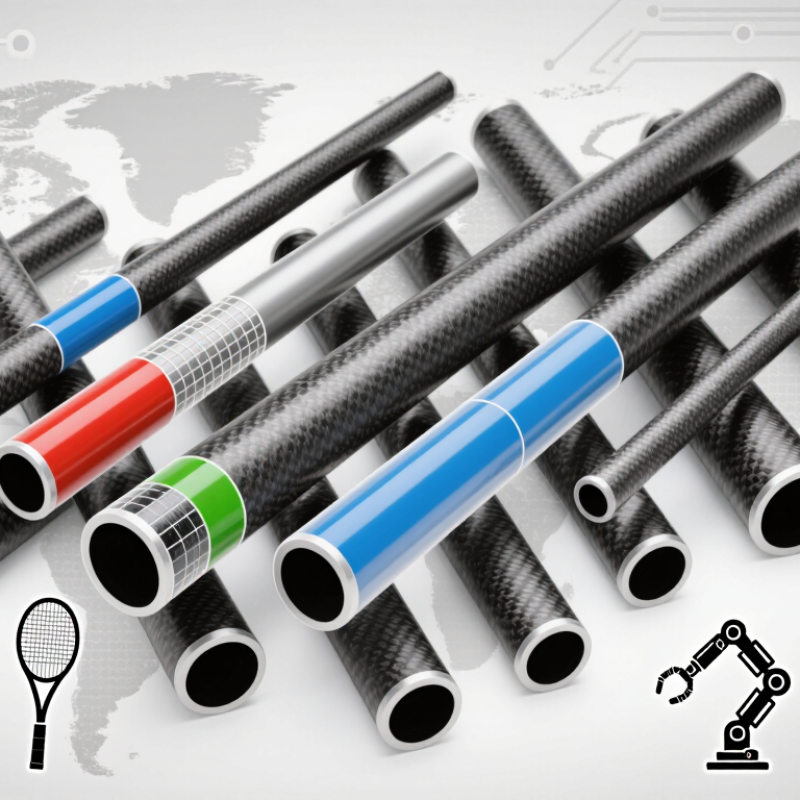
Understanding Carbon Tubes and Their Industrial Applications
Carbon tubes usually refer to carbon-fiber-reinforced polymer tubes, not ordinary carbon-steel pipes. Their strength comes from continuous fibers embedded in an epoxy or thermoplastic resin. Fiber direction matters. A tube built for axial compression may fail early under torsion if its layup is poorly designed.
Industrial buyers value high stiffness, low weight, corrosion resistance, and dimensional stability. Robotic arms use carbon tubes to reduce moving mass. Uncrewed aircraft use them for booms, landing structures, and frames. Medical equipment benefits from lightweight supports and low electromagnetic interference. The U.S. Department of Energy reports that a 10% reduction in vehicle weight can improve fuel economy by approximately 6–8%. That finding helps explain carbon composites in transport systems. The International Energy Agency reported nearly 14 million electric cars were sold globally in 2023, increasing demand for lighter structures and efficient components.
Performance depends on more than fiber percentage. Buyers should check modulus, tensile strength, wall thickness, fiber orientation, resin type, void content, and tolerance data. ISO or ASTM test methods improve comparison between suppliers. Conductivity can also matter near sensors and batteries. A lighter tube is not automatically better. In practice, poor end fittings, drilling damage, or sudden impact can control service life. This is where supplier evidence matters: batch records, inspection reports, sample testing, and clear application limits. Sometimes, the specification is incomplete. That deserves review before volume purchasing.

Key Criteria for Evaluating Global Carbon Tube Suppliers
When evaluating carbon tube suppliers, buyers should inspect evidence, not polished claims. MarketsandMarkets estimated the global carbon fiber market at about USD 4.5 billion in 2023, with continued growth through 2028. That expansion increases supplier choices, but not necessarily supplier quality.
Request resin-system details, fiber grade, winding method, and cure conditions. Confirm outer diameter, wall thickness, straightness, and cut-length tolerances. A capable supplier should provide recent test reports, batch numbers, and material traceability. ISO 9001 certification helps, but it does not replace product testing. Ask for tensile, compression, flexural, and interlaminar results when the tube carries structural loads. Small samples matter.
Review production capacity against your forecast. Industry delivery surveys often show that lead-time reliability weakens during demand spikes, especially for custom profiles. Ask how many tubes can be produced weekly, not merely the annual capacity. Check packaging, moisture protection, export documentation, and replacement procedures. These details affect real landed cost.
Price needs context. A cheaper tube may hide thicker tolerances, inconsistent fiber alignment, or weak inspection records. Yet an expensive supplier is not automatically safer. I have seen technically impressive samples fail to represent routine production. A supplier scorecard should include quality, responsiveness, capacity, testing, and corrective-action history. Leave room for doubt. Supplier performance must be rechecked after approval. Sources: MarketsandMarkets, Carbon Fiber Market 2023; ISO 9001:2015; ASTM D3039 and ASTM D790.
Regional Profiles of Leading Carbon Tube Manufacturers
Carbon tube manufacturers differ sharply by region, even when their catalogs look similar. East Asian producers often combine automated pultrusion lines with high-volume filament winding. Their tubes suit robotics, drones, sporting equipment, and lightweight frames. Buyers should request fiber orientation data, resin specifications, and batch records before comparing prices.
European manufacturers commonly emphasize traceability, dimensional control, and engineered assemblies. Their workshops may support custom mandrels, tight tolerances, and documented testing for aerospace, medical, or industrial applications. North American suppliers often focus on rapid prototyping, structural customization, and responsive technical service. Some maintain short production runs, which helps buyers test a design before committing to larger quantities. That flexibility can cost more.
Regional strengths are not fixed rules. A smaller factory may deliver better inspection than a larger exporter. I have seen polished samples hide inconsistent wall thickness. Ask for inspection reports. Check ovality, surface finish, compression behavior, and joining performance. Climate also matters: humid shipping routes can affect packaging and storage conditions. Manufacturers in emerging production regions may offer strong value, but communication gaps can slow corrective action. This deserves honest attention. Global buyers should evaluate engineering experience, export documentation, sample consistency, and after-sales response beside unit price. A reliable supplier explains limitations clearly, including what its process cannot guarantee.
Comparing Product Quality, Certifications, and Customization Options
Choosing the 10 best carbon tube suppliers for global buyers requires more than comparing prices. Product quality should be checked through fiber alignment, resin consistency, surface finish, and dimensional accuracy. A reliable supplier can provide batch records, tensile data, and inspection reports. I also recommend requesting samples before discussing large orders. Small defects often appear near drilled holes or bonded joints.
Certifications add confidence, but they need verification. Look for quality management certification, material traceability, and test reports issued by recognized laboratories. For aerospace, automotive, or industrial applications, ask whether production controls match the required industry standards. Some documents may be outdated. That is worth checking carefully. Customization is equally important. Strong suppliers can adjust tube length, wall thickness, weave pattern, color, connector design, and drilling positions. They should explain minimum order quantities and tooling charges clearly.
Tips: Compare at least three samples under the same test conditions. Measure weight, diameter, stiffness, and surface defects. Ask how rejected products are handled. A supplier that welcomes technical questions usually supports better long-term cooperation. Still, communication alone proves little. I once treated fast replies as a quality signal, but later found inconsistent dimensions in repeated samples. Build your shortlist from evidence, not confidence. Choose suppliers with stable production records, responsive engineers, and realistic delivery schedules.
| Rank | Supplier Profile | Primary Carbon-Tube Construction | Common Tube Forms | Typical Size Capability | Typical Dimensional Tolerance | Quality-Control Focus | Relevant Certifications or Standards | Customization Options | Typical MOQ | Typical Lead Time | Best-Fit Applications | Overall Fit |
|---|---|---|---|---|---|---|---|---|---|---|---|---|
| 1 | Supplier Profile 01 Aerospace-grade focus | High-strength carbon/epoxy prepreg with controlled fiber orientation | Round, square, rectangular, tapered | Outside diameter approximately 5–150 mm; custom lengths available | OD typically ±0.10–0.25 mm after machining | Ultrasonic inspection, fiber-angle verification, cure-record review | ISO 9001AS9100 preferredASTM D3039 testing | Lay-up schedule, wall thickness, inserts, drilled holes, surface finish, cut-to-length | 10–25 pieces for standard sizes; engineering review for prototypes | 4–8 weeks | Aircraft interiors, UAV structures, precision robotic arms | ★★★★★ |
| 2 | Supplier Profile 02 Pultrusion specialist | Continuous carbon/epoxy pultruded profiles with consistent cross-sections | Round, square, rectangular, flat-sided profiles | Outside diameter approximately 3–100 mm; standard lengths up to 6 m | Profile dimensions commonly ±0.20–0.50 mm | Resin-content checks, dimensional inspection, tensile and flexural sampling | ISO 9001ASTM D638ASTM D790 | Continuous lengths, custom dies, resin systems, matte or polished surfaces | 25–100 m for stock profiles; tooling may apply to custom sections | 3–7 weeks | Industrial frames, machine guarding, lightweight structural members | ★★★★★ |
| 3 | Supplier Profile 03 Filament-winding focus | Carbon/epoxy filament-wound tubes optimized for hoop and axial loads | Round, tapered, pressure-rated cylindrical tubes | Outside diameter approximately 20–400 mm; custom wall thickness | OD commonly ±0.25–0.75 mm before finish machining | Winding-angle control, void inspection, pressure or burst testing where required | ISO 9001ASTM D2290ASTM D1599 | Fiber angle, liner integration, end fittings, pressure rating, balancing features | 5–20 tubes depending on tooling and test requirements | 5–10 weeks | Pressure vessels, drive shafts, fluid-handling equipment | ★★★★★ |
| 4 | Supplier Profile 04 Precision-machined tubes | Woven or unidirectional carbon/epoxy laminate with post-cure machining | Round, oval, rectangular, multi-bore | Outside diameter approximately 8–250 mm; length up to 2 m typical | Finished features commonly ±0.05–0.15 mm | CMM measurement, concentricity inspection, surface-profile checks | ISO 9001ISO 2768ASTM D3171 | Precision bores, grooves, threads, bonded end fittings, tight concentricity | 10–50 pieces | 4–9 weeks | Optical equipment, semiconductor tools, laboratory instruments | ★★★★☆ |
| 5 | Supplier Profile 05 Sports and mobility focus | High-modulus carbon/epoxy with balanced axial and torsional performance | Round, tapered, bonded multi-section tubes | Outside diameter approximately 10–80 mm; common lengths up to 2 m | OD commonly ±0.15–0.40 mm | Weight consistency, stiffness testing, cosmetic and bond-line inspection | ISO 9001ASTM D3039ASTM D7264 | Custom stiffness, taper, graphics, bonding surfaces, drilled interfaces | 25–100 pieces | 3–6 weeks | Bicycles, mobility equipment, camera supports, sporting goods | ★★★★☆ |
| 6 | Supplier Profile 06 Large-diameter capability | Carbon fabric and unidirectional laminate for large structural shells | Large round, rectangular, split-shell, tapered | Outside diameter approximately 100–800 mm; length based on tooling | OD commonly ±0.50–1.50 mm before final machining | Laminate thickness mapping, vacuum integrity, visual and ultrasonic inspection | ISO 9001ASTM E2580ASTM D3171 | Segmented tooling, flanges, access ports, sandwich cores, structural joints | 1–10 assemblies | 8–16 weeks | Wind-energy equipment, marine structures, industrial robotics | ★★★★☆ |
| 7 | Supplier Profile 07 Rapid-prototyping focus | Prepreg or wet-lay carbon/epoxy for low-volume development programs | Round, square, custom molded sections | Outside diameter approximately 5–120 mm; short-run lengths | OD commonly ±0.30–0.80 mm before secondary machining | Material batch traceability, cure-cycle monitoring, basic mechanical testing | ISO 9001ASTM D3039ASTM D6641 | Fast tooling, prototype lay-ups, inserts, cut-outs, short production runs | 1–10 pieces | 2–5 weeks | R&D projects, university laboratories, prototype hardware | ★★★★☆ |
| 8 | Supplier Profile 08 High-volume production | Continuous pultruded carbon/epoxy with automated cutting and finishing | Round, square, rectangular, custom constant profiles | Outside diameter approximately 4–75 mm; continuous lengths available | Profile dimensions commonly ±0.25–0.60 mm | Statistical process control, batch sampling, automated dimensional checks | ISO 9001ISO 14001 preferredASTM D3917 | Custom die profiles, cut-length control, drilling, chamfering, packaging | 100–500 m for standard profiles | 4–10 weeks | Automation, electrical insulation, mass-produced components | ★★★★☆ |
| 9 | Supplier Profile 09 Corrosion-resistant systems | Carbon/epoxy tubes with protective coatings or integrated liners | Round, lined, pressure-bearing, chemically resistant tubes | Outside diameter approximately 15–300 mm | OD commonly ±0.25–0.75 mm; liner tolerance specified separately | Leak testing, coating adhesion, chemical-resistance and pressure testing | ISO 9001ASTM D4541ASTM D1599 | PTFE or polymer liners, protective coatings, flanges, seals, end fittings | 5–25 tubes | 6–12 weeks | Chemical processing, pumps, marine systems, water-treatment equipment | ★★★★☆ |
| 10 | Supplier Profile 10 Cost-sensitive sourcing | Standard-modulus carbon/epoxy with economical wet-lay or pultruded construction | Round, square, rectangular, standard stock tubes | Outside diameter approximately 3–100 mm; stock lengths commonly 1–3 m | OD commonly ±0.40–1.00 mm | Visual inspection, weight-per-length checks, basic dimensional verification | ISO 9001 preferredASTM D3039 testing available | Cutting, drilling, sanding, basic end finishing, standard resin and weave choices | 25–100 pieces or standard stock-length orders | 3–8 weeks | General industrial parts, displays, hobby equipment, non-critical supports | ★★★☆☆ |
Selecting the Best Supplier for International Procurement Needs
When comparing the 10 best carbon tube suppliers for global buyers, price should not lead the decision.
Material traceability, dimensional control, and export experience matter more. MarketsandMarkets reports that the global carbon fiber market may grow from approximately USD 4.6 billion in 2023 to USD 7.1 billion by 2028. This growth increases supplier choices, but not necessarily supplier quality.
Request production records, resin specifications, fiber orientation, and inspection results before approval.
A dependable supplier should explain tolerance limits clearly. Ask for samples cut from regular production, not specially prepared pieces.
Check whether the factory follows ISO 9001 procedures and can provide testing aligned with relevant ASTM or ISO methods.
Small details matter. A 0.3-millimeter deviation can affect assembly, vibration, or sealing performance.
International procurement also requires practical evidence.
Review lead times, packaging methods, customs documents, and responses to technical questions. The World Bank’s Logistics Performance Index shows persistent differences in customs efficiency and shipment reliability between markets.
Therefore, a lower quotation may create higher landed costs.
I would also examine claims carefully; certificates can confirm a process, but they cannot replace independent testing. My own caution is simple: supplier rankings are useful screening tools, yet real samples often reveal weaknesses that polished catalogs hide.