| Type I Borosilicate Glass Vial | Powders, granules, small-volume pastes, and injectable bone substitutes | Excellent chemical resistance and strong moisture and oxygen protection; transparent for visual inspection | Very low extractables; low gas permeability; breakage and sharp-fragment risk require protective secondary packaging | Easy to identify and label; opening may require a separate transfer device or sterile instrument | Commonly compatible with validated gamma radiation, electron beam, or ethylene oxide processes; process validation is required | Medium | Products requiring high chemical stability, long shelf life, or strong regulatory familiarity |
| Cyclic Olefin Polymer (COP) Vial | High-value powders, granules, pastes, and moisture-sensitive formulations | Low moisture absorption, low extractables, good clarity, and strong dimensional stability | Low breakage risk and good cleanliness; compatibility with the formulation and sterilization method must be tested | Lightweight and easy to handle; can support modern snap-fit or luer-based closure systems | Often suitable for gamma, electron beam, or ethylene oxide sterilization when validated for the selected grade and dose | High | Premium sterile products where reduced breakage and high product protection justify higher packaging cost |
| High-Density Polyethylene (HDPE) Bottle | Dry bone chips, granules, powders, and larger-volume graft materials | Good impact resistance and moisture protection; opaque grades protect light-sensitive contents but prevent visual inspection | Low breakage risk; possible permeation or adsorption concerns should be assessed for sensitive formulations | Wide opening supports scooping or direct dispensing; closure torque and seal integrity must be controlled | Commonly used with ethylene oxide; some grades support radiation sterilization after material and dose validation | Low | Cost-sensitive products, larger fill volumes, and distribution routes with high handling or transport risk |
| Polypropylene (PP) Cup or Jar | Granules, bone chips, putties, and ready-to-use solid or semi-solid fillers | Good chemical resistance, low density, and moderate moisture barrier; clarity varies by grade | Lightweight and impact-resistant; closure design is critical to prevent contamination and leakage | Wide opening allows fast access in the operating room; suitable for spatulas and other sterile tools | Commonly compatible with ethylene oxide; radiation compatibility depends on grade, additives, and sterilization dose | Low | Routine bone-filling products requiring economical, lightweight, and easy-access packaging |
| Prefilled Polymer Syringe | Injectable pastes, putties, calcium phosphate cements, and moldable fillers | Usually based on medical-grade cyclic olefin polymer or polypropylene; provides a closed delivery path | Reduces open handling and contamination opportunities; requires testing for extractables, plunger compatibility, and dose uniformity | High usability and precise delivery; may require a cannula, mixing step, or dedicated applicator | Often compatible with ethylene oxide or radiation processes depending on the syringe material and formulation | High | Operating-room efficiency, controlled dosing, minimally open handling, and injectable or moldable products |
| Sterile Foil-Laminate Pouch | Flat-packed bone chips, granules, powders, and flexible or irregularly shaped graft products | Very strong moisture, oxygen, and light barrier when correctly sealed; lightweight and space-efficient | No glass breakage risk; seal integrity, puncture resistance, and particulate control are essential safety factors | Low transport weight and compact storage; opening can be less convenient than a rigid container and may require a sterile tray | Frequently used with ethylene oxide or radiation sterilization; the laminate and seal must be validated for the process | Low to Medium | International shipping, moisture-sensitive products, compact logistics, and single-use sterile formats |
| PETG Thermoformed Tray | Pre-shaped graft blocks, membranes, instruments, or bone-filling kits | Good visibility, rigidity, and dimensional consistency; barrier performance depends on the lid and tray system | Protects shaped products from compression; corners and cavities must be designed to avoid product damage and retained particles | Organized presentation and easy product identification; larger footprint than pouches or small vials | Commonly compatible with ethylene oxide; radiation suitability depends on material grade and product stability | Medium | Procedure kits, shaped grafts, multi-component packs, and products needing organized presentation |
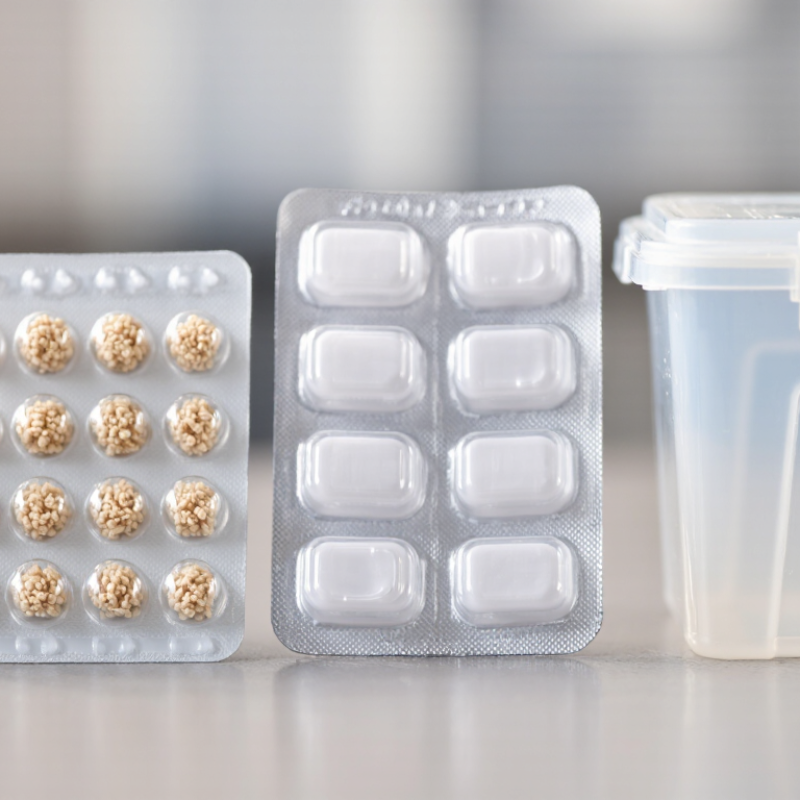
| Blister Pack with Medical-Grade Lid | Small preformed graft pieces, membranes, plugs, and individually portioned fillers | Good product visibility and unit separation; moisture and oxygen protection depend on the blister resin and lidding foil | Supports individual dose protection and tamper evidence; seal quality and peel performance are critical | Fast opening and clear identification of each unit; limited capacity for bulky or irregular products | Often suitable for ethylene oxide or radiation sterilization after package integrity and material compatibility testing | Medium | Individually packaged graft pieces, controlled dosing, and products requiring clear unit presentation |